
I've sat on both sides of this table. I co-founded an agency, BuzzShift, and sold it twice. Today I run FlightPlan Ventures, a venture studio I co-founded with Bryan DeLuca. Same skills, same playbooks, completely different deal. And after 15+ years building consumer brands, I'm convinced the agency model is broken for founders.
Not because agencies are full of bad people. Because the incentives point the wrong way.
The moment the agency model broke for me
Years ago we were running growth for a men's grooming brand on a $20,000 a month retainer. We built the engine. Positioning, site, creative, paid, retention. The brand took off and sold to a public company.
Great day for the founders, and they earned it. But I remember thinking, what the heck just happened? We built the machine and walked away with an invoice. No equity, no rev share, no upside. That's when I knew the model was wrong.
What an agency actually sells you
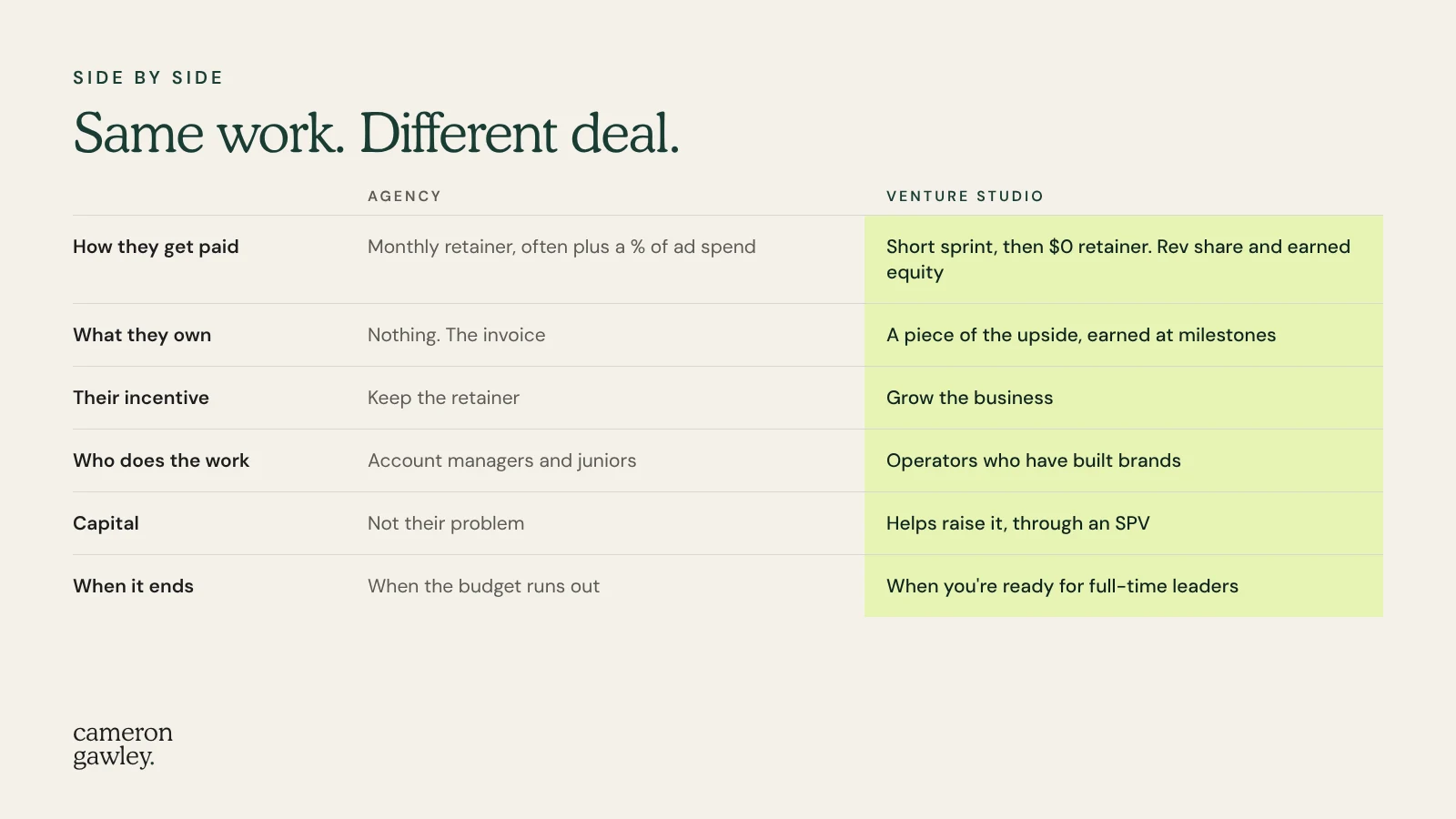
An agency sells time. You pay a retainer every month, often plus a percentage of your ad spend, whether the business grows or not. The agency's real job is to keep the retainer. That's not cynical. It's just how the economics work.
Here's what that does to your brand:
- The incentive is activity, not outcomes. More campaigns, more decks, more reports. None of it has to move your contribution margin.
- A percent of spend rewards spending. If they get paid on your ad budget, nobody is fighting to lower your customer acquisition cost.
- The senior people sell it. The juniors run it. You meet the founder in the pitch and an account manager in month two.
- They leave when the budget runs out. Usually right when you need help the most.
What a venture studio does differently
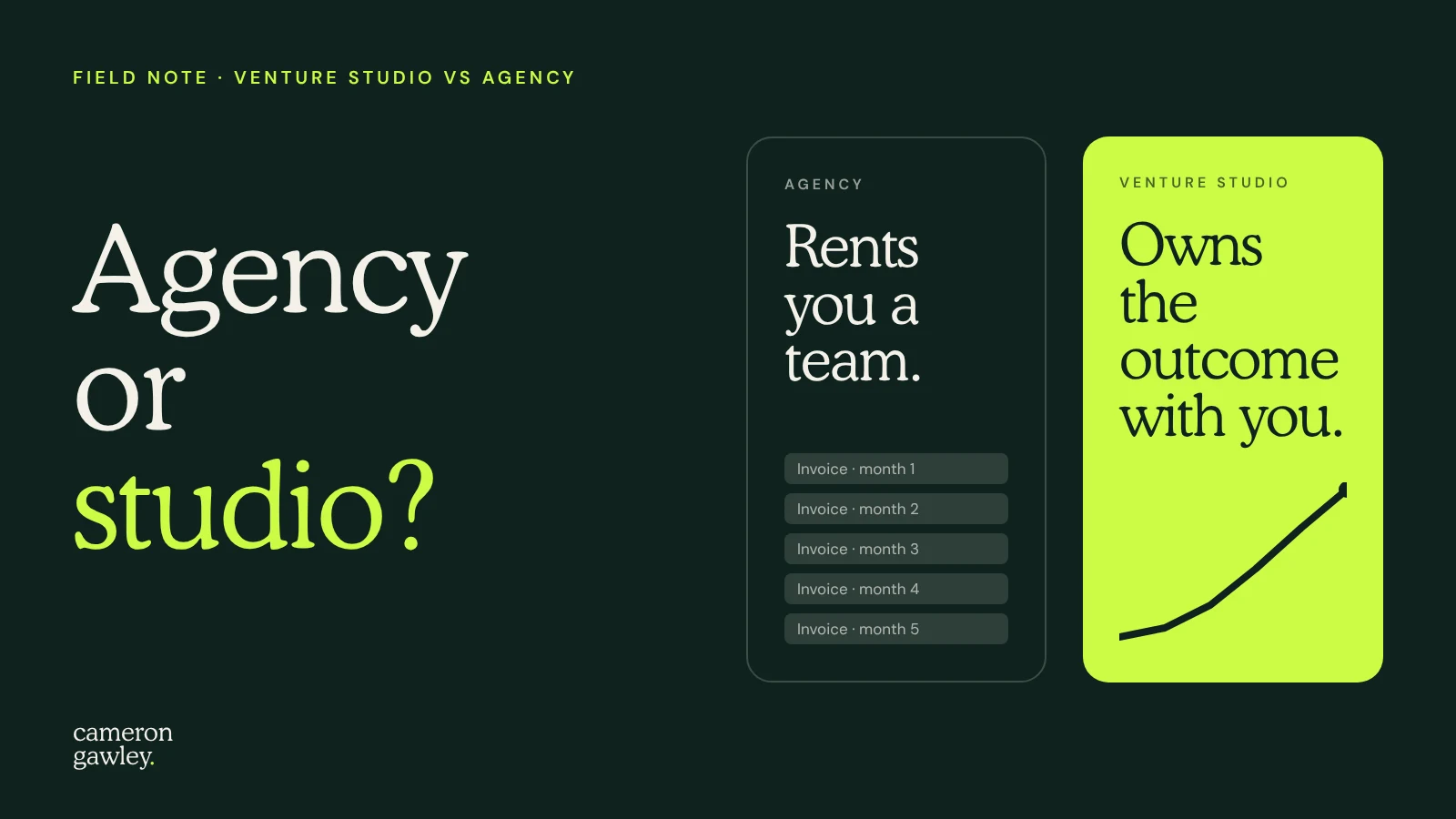
A venture studio is an operating partner, not a vendor. We get in the trenches, build the business with you, and get paid when the business works. Agencies rent you a team. A studio owns the outcome with you.
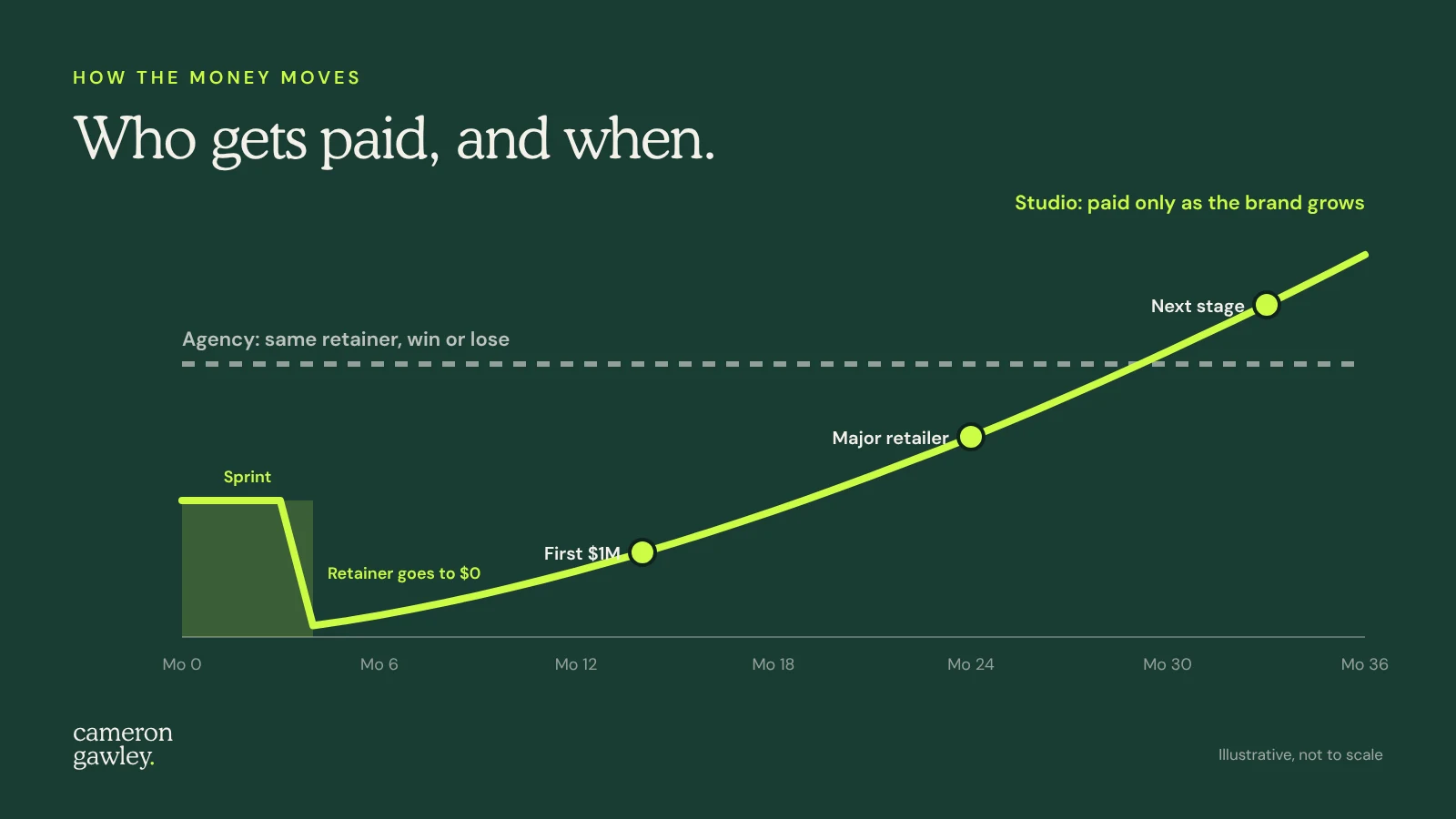
The key difference is how the money moves. An agency's line is flat: same retainer, win or lose. A studio's line starts small, drops to zero, then only climbs if your brand climbs.
How we build at FlightPlan
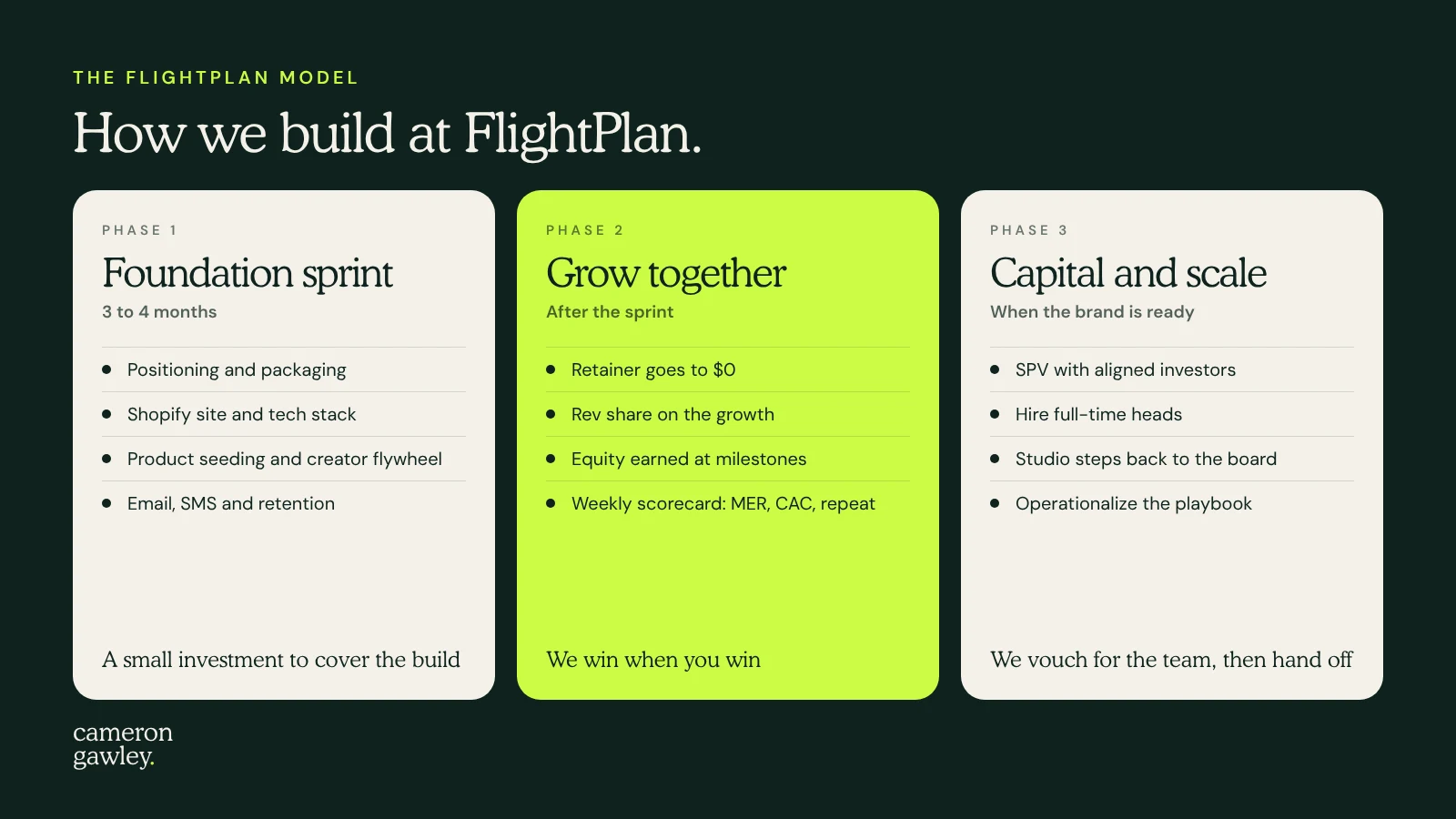
We run it in three phases. Each one earns the right to the next.
Phase 1: Foundation sprint. Three to four months. We reposition the brand, fix the packaging, rebuild the Shopify site and tech stack, launch product seeding and the creator flywheel, and build email, SMS and retention. There's a small investment from the founder to cover the build, and we subsidize the rest. If you stacked up every piece of that as separate agencies and hires, you'd pay a fortune.
Phase 2: Grow together. After the sprint, the retainer goes to $0. We move to rev share and equity. Now the only way we get paid is if the business grows. We run a weekly scorecard on four numbers: MER (total revenue divided by total marketing spend), new-customer CAC, repeat rate and contribution margin.
Phase 3: Capital and scale. When the brand is ready, we help raise. We put together an SPV, a special purpose vehicle that lets a group of investors come into one deal together, and bring in aligned investors from our network. Then we hire full-time heads of acquisition, retention and CX, and we step back to the board.
Equity is earned, not taken
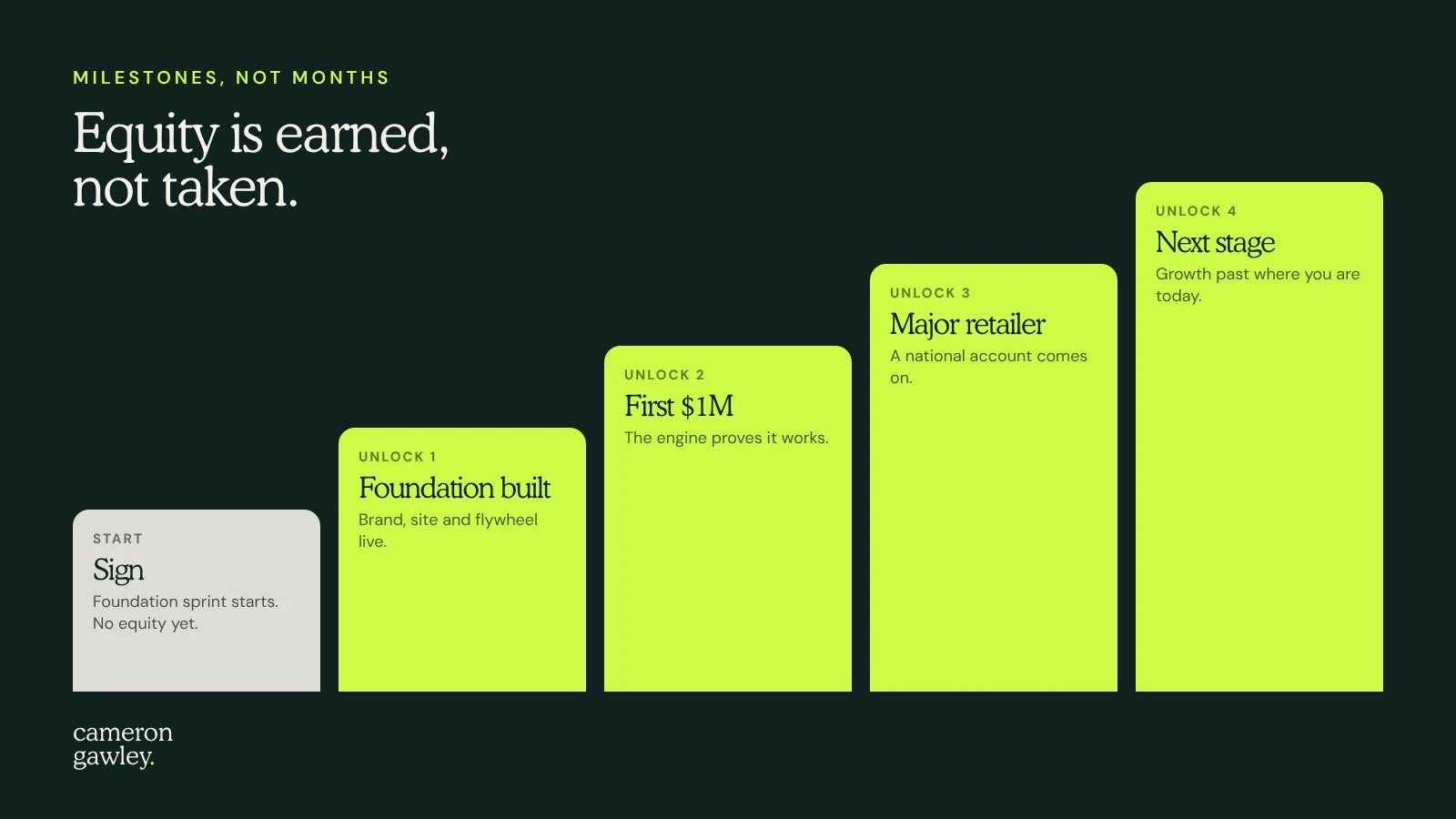
We could come in, take a big chunk of equity and call ourselves co-founders. I don't think that's fair to the founder, and it's not how trust gets built. So we take a smaller piece and earn it in tranches.
When the foundation is live, that's one unlock. When you cross your first $1M, that's another. When a major retailer comes on, another. We have to prove ourselves at every step. Milestones, not months.
What the deal can look like
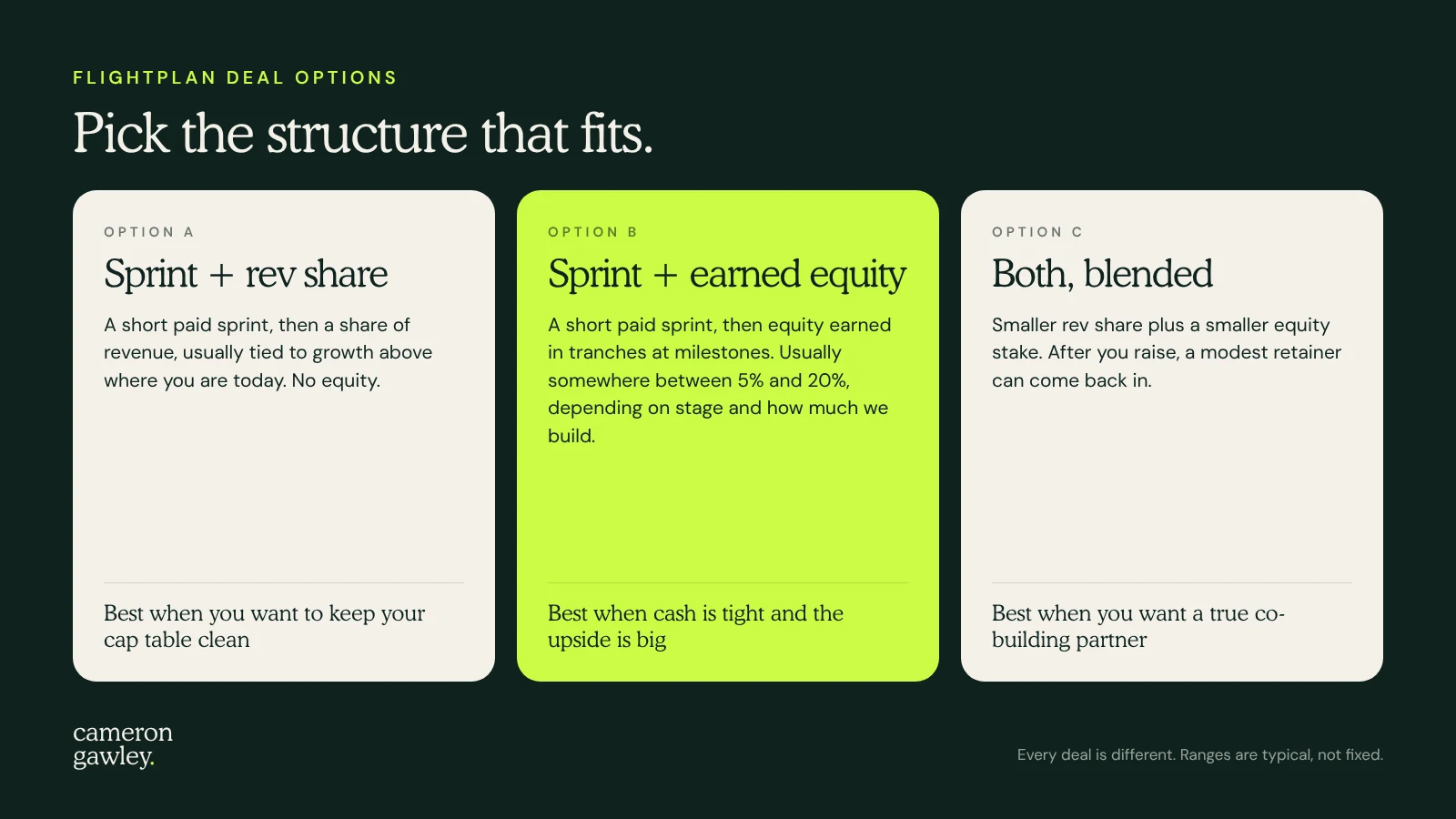
There's no one-size deal, and I'd be skeptical of anyone who says there is. Most of ours land in one of three shapes.
- Sprint plus rev share. A short paid sprint, then a share of revenue, usually tied to growth above where you are today. No equity. Good when you want to keep your cap table clean.
- Sprint plus earned equity. A short paid sprint, then equity earned in tranches. Usually somewhere between 5% and 20%, depending on your stage and how much we're building. Good when cash is tight and the upside is big.
- Both, blended. A smaller rev share and a smaller equity stake. After a raise, a modest retainer can come back in so the team is fully staffed.
The more cash you put in up front, the less equity we need. The less cash, the more we earn it on the back end. Either way, the bulk of what we make only shows up if your business grows.
The real cost of a growth team
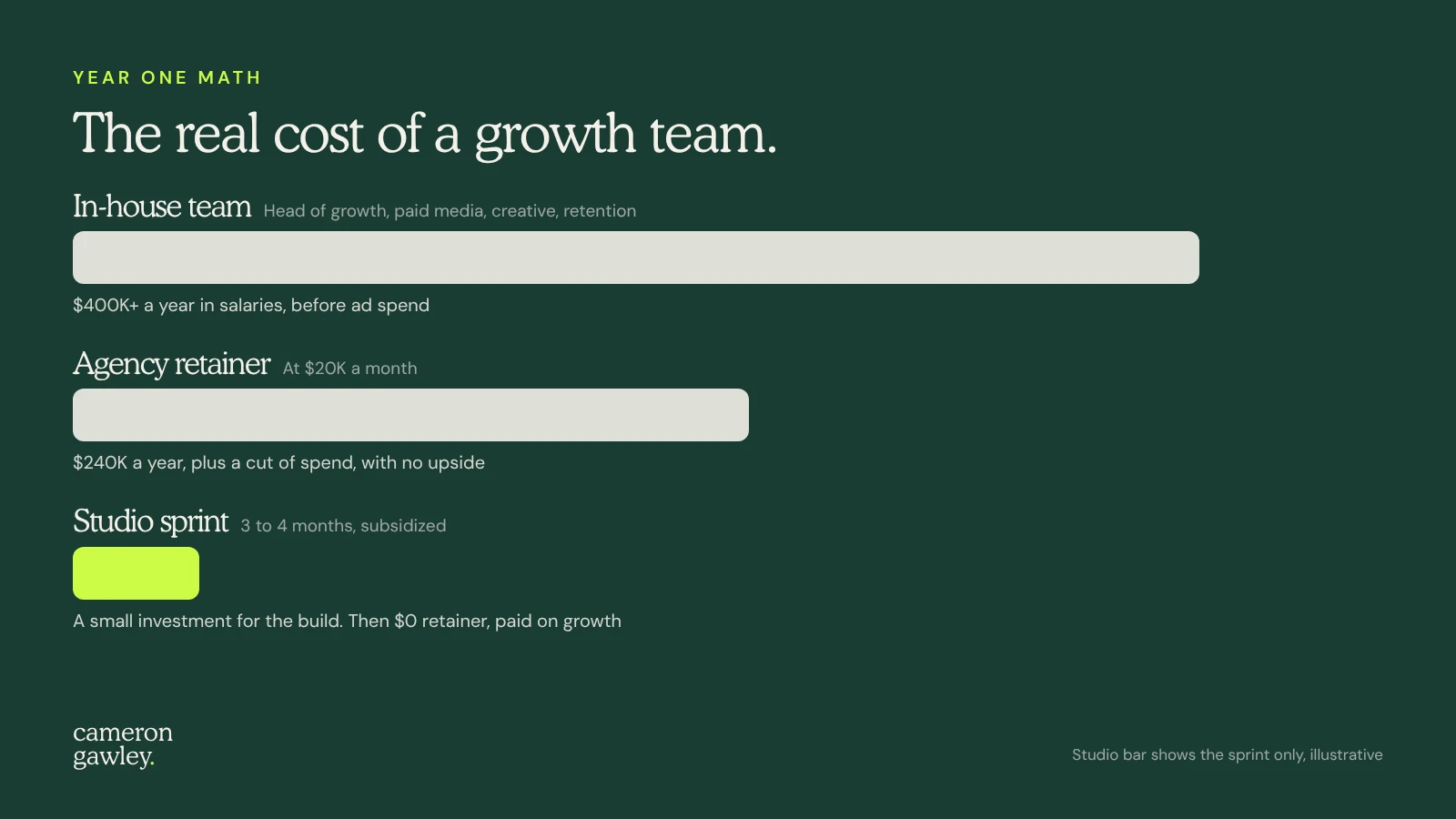
Most founders think the choice is agency or hire. Run the math on the hire first. A head of growth, a paid media lead, a creative strategist and a retention lead is $400K+ a year in salaries before you spend a dollar on media. One recent grad running social can cost $150K in some markets. Your burn rate explodes before you've proven anything.
An agency at $20K a month is $240K a year, plus a cut of your spend, with zero upside for them if you win. A studio gives you a shared, senior team for a short subsidized sprint, then gets paid on growth. Same engine. A fraction of the operating cost.
Why this matters when you raise
Investors don't just back a product. They back a founder with a team that can execute. If you look like a great jockey with no team around you, the check gets smaller or doesn't come at all.
When FlightPlan signs on with equity, we become your accountability layer. We can vouch for the plan because we're in it with you. And here's the part founders miss: get the brand positioning right, and raising capital gets a lot easier.
What this looks like in practice
Sweet Addison's was selling around $5K a month at farmers markets. We repositioned the brand, redid the packaging, built collaborations and rebuilt the site. It became a 7-figure brand in under a year.
As fractional CMO, I helped take Gardencup from $0 to a $29M run rate in 18 months. Same playbook, same order of operations. The difference now is that we own a piece of what we build.
Who a venture studio is not for
A studio isn't for everyone, and that's on purpose.
- You just want hands to run ads. Hire a media buyer. You don't need a partner.
- You don't believe in your product. We need a product people love and a co-manufacturer who can make it right. Positioning can't fix a bad flavor profile.
- You want a vendor, not a partner. If you'd rather manage us than build with us, an agency is a better fit.
The founders who win with a studio want somebody to lock arms with from day one. That's the whole point. I only win when you win.
If you want to see where your brand stands before any of that, start with the Growth Audit. It's the same lens I use before we ever talk about a partnership, or you can see how we work at FlightPlan Ventures.