

Introduction
Creating a consistent employer branding strategy is more important now than ever. Here's a quick answer:
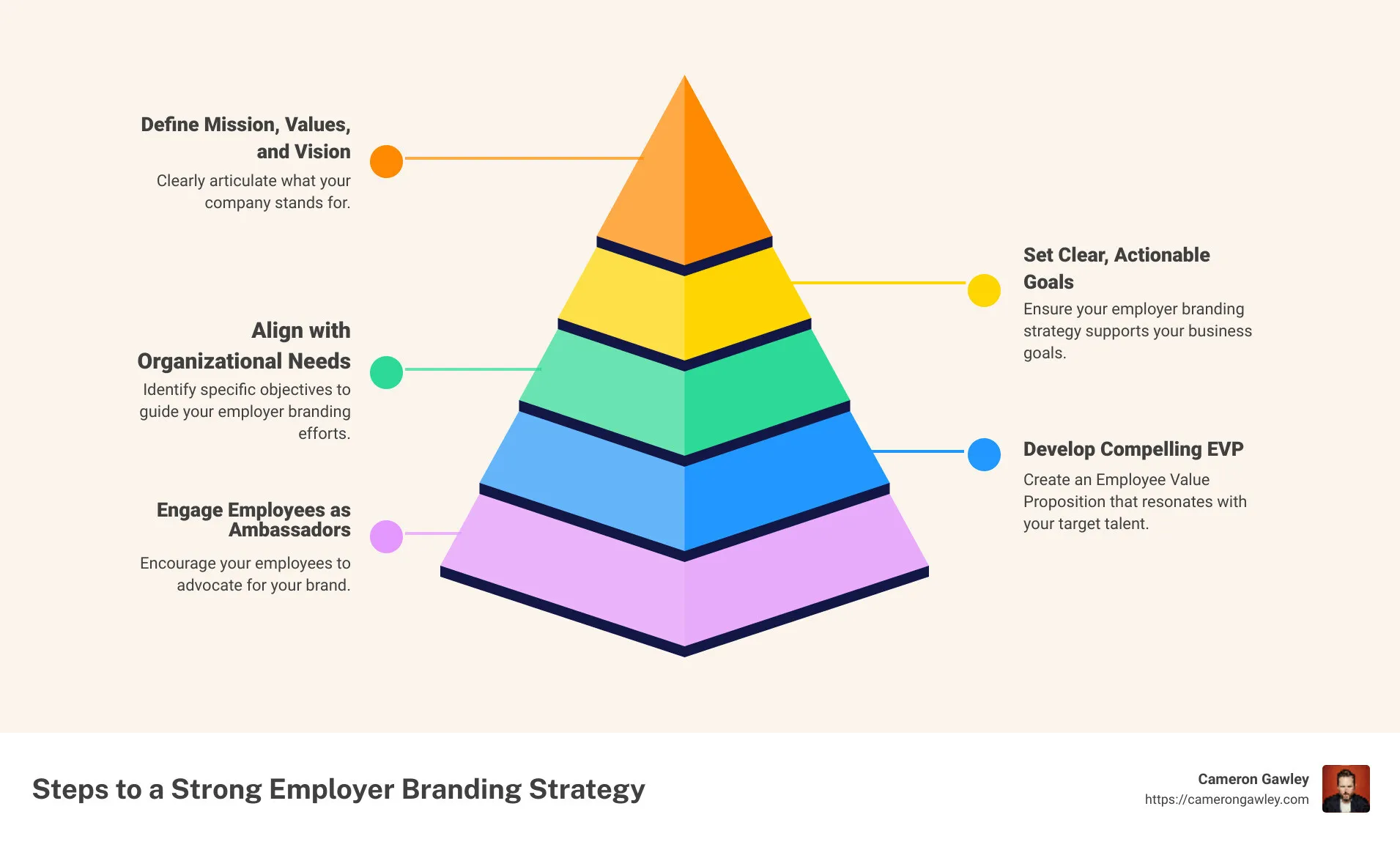
- Define your company's mission, values, and vision.
- Set clear, actionable goals for your employer brand.
- Align your strategy with organizational needs.
- Develop a compelling Employee Value Proposition (EVP).
- Engage employees and turn them into ambassadors.
- Use appropriate communication channels.
- Track key performance indicators (KPIs).
- Continuously improve your strategy based on feedback.
Employer branding shapes how your company is perceived as a place to work. It's about the reputation you have among potential and current employees. This impacts your recruitment quality and employee retention, both critical to your business success.
For instance, a survey found that 86% of job seekers avoid companies with poor reputations. Building a strong employer brand can cut hiring costs and significantly decrease staff turnover.
I'm Cameron Gawley, a seasoned expert in brand strategy and growth marketing. With years of experience helping companies like Everlane and Takis develop their branding strategies, I can guide you through how to build an employer branding strategy effectively.
What Is Employer Branding?
Employer branding is the reputation you have as an employer among your employees and the workforce. It’s also how you market your company to job seekers and internal employees.
Definition
Employer branding is how your company is perceived as a place to work. It encompasses your company’s mission, values, culture, and personality. This brand affects how potential employees see you and how current employees talk about you.
Reputation
Your reputation as an employer is critical. A survey found that 86% of job seekers avoid companies with poor reputations. This means your employer brand can make or break your hiring efforts. A strong employer brand not only attracts top talent but also helps retain your current employees.
Employee Perception
What do your employees say about working at your company? This is a big part of your employer brand. 69% of employees think it’s very important that their employer has a brand they’re proud to support. If your employees are happy and engaged, they’ll spread the word and act as ambassadors for your brand.
Market Perception
Beyond your employees, how does the general public view your company as a place to work? This includes job seekers and even your competitors. A positive market perception can help you stand out in a crowded job market and attract the best talent.
In summary, employer branding is all about how you are seen as an employer. It’s shaped by your company’s culture, values, and how you treat your employees. A strong employer brand can reduce hiring costs, decrease turnover, and make your company a place where people want to work.
Next, let's explore why employer branding is so important.
Why Employer Branding Is Important
Employer branding is not just a buzzword. It plays a crucial role in multiple aspects of your business, especially in recruitment, retention, performance, and profitability. Let's break down why it matters.
Recruitment
A strong employer brand attracts more high-quality job applicants. According to LinkedIn, companies with a well-maintained employer brand see 50% more qualified applicants.
Think about it: 84% of job seekers consider a company's reputation before applying for a job. If your brand is strong, you become a magnet for top talent.
Retention
Retention is another area where employer branding shines. Companies that invest in their employer brand experience a 28% reduction in employee turnover. Losing an employee can cost as much as twice their annual salary, so retaining your talent saves money and maintains productivity.
Engagement is key here. Employees who feel valued and engaged are less likely to leave. Companies with high employee engagement see 18% higher productivity and 23% higher profitability.
Performance
An engaged workforce is not just more productive; it's also more innovative and committed to the company's goals. Employees who understand and believe in your brand are more likely to go the extra mile. This boosts overall performance and helps the company achieve its objectives.
Profitability
Strong employer branding directly impacts your bottom line. High engagement and low turnover contribute to higher profitability. According to research, companies with strong employer brands can reduce their cost-per-hire by 50%. Additionally, they don't need to offer as high a salary to attract top talent, saving on compensation costs.
Statistics
Here are some compelling statistics to consider:- 86% of women and 67% of men in the U.S. wouldn’t apply for a job at a company with a bad reputation.- 75% of job seekers consider an employer’s brand before applying.- Companies with poor employer brands need to offer a 60% pay increase to attract top job seekers.
In summary, a strong employer brand is essential for attracting and retaining talent, boosting performance, and increasing profitability. It's not just about being seen as a good employer; it's about being a great place to work.
Next, we'll dive into how to build an employer branding strategy.
How to Build Employer Branding Strategy
Align Your Strategy With Organizational Needs
Start by aligning your employer branding strategy with your business objectives. Understand what your organization aims to achieve in the next 12 to 36 months. This alignment helps ensure that your branding efforts support these goals and address any talent gaps.
Questions to Consider:
- What are the company's short-term and long-term goals?
- What products or services are in the pipeline?
- What skills will be needed to meet these objectives?
Set Actionable Objectives
Setting clear, actionable objectives is crucial. These objectives should be specific, measurable, and time-bound.
Steps to Set Objectives:
- Target: Identify a specific goal (e.g., reduce time-to-hire by 20%).
- Measure: Establish metrics to track progress (e.g., time-to-hire, cost-per-hire).
- Plan: Allocate resources, create a timeline, and set deadlines.
- Assign: Delegate tasks to team members and hold them accountable.
Define Relevant KPIs
Key performance indicators (KPIs) help you measure the success of your objectives. Choose KPIs that are attainable, accurate, and actionable.
Common KPIs:
- Cost-per-hire: Measures the financial efficiency of your recruitment process.
- Time-to-fill: Tracks how quickly positions are filled.
- Quality of hire: Assesses the performance and retention of new hires.
Develop a Measurement Plan
A solid measurement plan is essential for tracking and analyzing data.
Key Components:
- Data Tracking: Use tools like applicant tracking software (ATS) to gather data.
- Data Collection: Regularly collect data from various sources (e.g., Google Analytics, finance metrics).
- Analysis: Analyze the data to identify trends and opportunities.
- Reporting: Share findings with stakeholders to inform decision-making.
Allocate Resources Upfront
Decide whether to use internal teams or external agencies for your branding efforts. Define roles and responsibilities to minimize roadblocks.
Options:
- Internal Teams: Cost-effective but may lack specialized skills.
- External Agencies: Provide expertise but can be costly.
Create Target Candidate Personas
Develop semi-fictional representations of your ideal candidates. Use interviews and feedback to understand their motivations and demographics.
Criteria to Consider:
- Basics: Job title, salary requirements, qualifying criteria.
- Background: Education, work history, skills.
- Personal: Goals, motivations, interests.
Develop a Compelling Employee Value Proposition
Your Employee Value Proposition (EVP) should clarify what candidates can expect from your company and what you expect from them. This forms the foundation of your recruitment communications.
Elements of an EVP:
- Expectations: What the company offers and expects.
- Values: Core company values and culture.
- Communication: Consistent messaging across all materials.
Examine Your Application Process
Understand the applicant's point of view by gathering feedback from candidates and recent hires. This helps identify areas for improvement.
Questions to Ask:
- Was the application process user-friendly?
- How long did it take to complete?
- What were the pain points?
Don’t Forget About Retention
Employee retention is just as important as recruitment. Engaged employees are more likely to stay and advocate for your brand.
Focus Areas:
- Engagement: Regular check-ins and feedback loops.
- Profitability: Employees who feel valued are more productive.
- Advocacy: Encourage employees to share their positive experiences.
Determine Your Distribution Mix
Decide how to distribute your employer branding content across various channels.
Types of Media:
- Owned Media: Company website, blog, social media.
- Earned Media: Reviews, testimonials, media coverage.
- Paid Media: Job ads, sponsored content, PPC campaigns.
In the next section, we'll explore how to execute your employer branding strategy effectively.
How to Execute Your Employer Branding Strategy
Tailor Employer Branding Materials to Your Candidate Personas
Creating materials that speak directly to your ideal candidates is crucial. Segmenting your audience helps tailor messages that resonate. Use your candidate personas to guide this process.
Storytelling is key. Share real stories from current employees. For example, "A Day in the Life" videos or blog posts can be very engaging. These stories show what it's like to work at your company.
Update your careers page with these materials. Make it visually appealing and easy to navigate. Include videos, employee testimonials, and clear job descriptions.
Don't forget social media campaigns. Share content that highlights your company culture, employee achievements, and job openings. Platforms like LinkedIn and Instagram are great for this.
Create a Content Calendar
A content calendar keeps your strategy organized. Start with a brainstorming session to generate ideas for blog posts, videos, and social media updates.
Consider your budget. Quality content takes time and money. Focus on one project at a time to avoid spreading resources too thin.
Distribute tasks among your team. Assign specific roles and responsibilities to ensure everyone knows what to do.
Set deadlines. Sync calendars and hold team members accountable. Regular check-ins can help keep everyone on track.
Watch for Common Implementation Roadblocks
Up to 75% of organizations struggle with strategy implementation. Here are some common roadblocks:
- Team distrust: Only 9% of managers trust colleagues in other functions. Encourage transparent communication and collaboration.
- Top-down execution: Relying too much on the CEO can weaken mid-level management. Empower mid-level managers to make decisions and drive implementation.
- Adaptability: Be willing to pivot when necessary. A rigid strategy can lead to missed opportunities.
Make Sure Your Employees Understand the Strategy
Your employees can be your best brand ambassadors. Employee referrals are a cost-effective way to find top talent.
Communication is key. Make sure every employee understands the employer branding strategy. Hold meetings or send regular updates to keep everyone in the loop.
Empower employees to share the company's message. Some firms may be uneasy about this, but it's crucial. Provide guidance like talking points or a social media policy to ensure they stay on message.
In the next section, we'll explore how to optimize your employer branding strategy for continuous improvement.
How to Optimize Your Employer Branding Strategy
Test Your Message
Testing your employer branding message is crucial. It helps you see what resonates with your audience and what doesn't.
A/B testing is a simple yet effective method. You create two versions of a message and see which one performs better. For example, if you're unsure whether a testimonial or a statistic will engage more candidates, test both. Send one version to half your audience and the other version to the other half. The one with better engagement wins.
Multivariate testing takes this a step further by testing multiple variables at once. This method is more complex and requires a larger audience. But it can give you insights into which combination of elements (like text, images, and calls to action) works best together.
Performance comparison is key. Use metrics like click-through rates, application rates, and engagement rates to see which message performs better. Regular testing ensures you're always improving and staying relevant.
Don’t Be Afraid to Course Correct
There will be times when your strategy needs adjustments. Reassess your strategy to see if it still aligns with your organizational needs. If it's not meeting the needs, it's time to rethink your approach.
Examine your KPIs to see what's working and what's not. If your results are falling short, dig into the data to find out why. If you've met your objectives, set new priorities and start again.
Resource allocation is another crucial aspect. If your budget or team size changes, adjust your strategy accordingly. Streamline if resources are limited, or expand your efforts if you have more to work with.
Repeat, Repeat, Repeat
Employer branding is not a one-time effort. Continuous improvement is the name of the game. Once you've optimized your strategy, start over.
Reassess your needs and determine if your strategy is still relevant. Set new objectives to address fresh challenges or opportunities. Develop new candidate personas and refine your employee value proposition.
Top-performing companies treat their employer branding strategy as a work in progress. They never miss an opportunity to refine their approach and improve results.
By following these steps, you ensure that your employer branding strategy stays effective and aligned with your organizational goals.
10 Employer Branding Strategy Examples
1. Tableau
Tableau focuses on creating a culture of innovation and inclusivity. They use their careers page to highlight employee stories and their commitment to diversity. They also host events like "Tableau Conference" to showcase their vibrant community and attract top talent.
2. Buffer
Buffer is known for its radical transparency and remote-first culture. They openly share their salary formula and even their revenue numbers. This level of transparency builds trust and attracts candidates who value openness and flexibility.
3. Zayo
Zayo leverages its commitment to cutting-edge technology and growth opportunities. Their employer branding focuses on career development and the chance to work on impactful projects. They also highlight their inclusive culture and diverse workforce.
4. Girls Who Code
Girls Who Code aims to close the gender gap in tech. They use powerful storytelling and real-life success stories to attract candidates passionate about their mission. Their careers page emphasizes their commitment to diversity and empowerment.
5. Google
Google is renowned for its innovative culture and employee perks. Their careers page features videos of employees discussing their experiences. Google also promotes its commitment to diversity and inclusion through various initiatives and programs.
6. Checkr
Checkr focuses on fair chance hiring and social impact. They use their employer brand to highlight their mission to build a fairer future. They also share stories of employees who have benefited from their inclusive hiring practices.
7. Microsoft
Microsoft leverages its global impact and commitment to innovation. Their careers page features employee testimonials and showcases their diverse and inclusive culture. They also highlight their various employee resource groups and community initiatives.
8. Starbucks
Starbucks creates a sense of community among its employees, referring to them as "partners." Their social media accounts promote their employer brand and interact with job seekers. They also emphasize their commitment to diversity and inclusion.
9. HubSpot
HubSpot uses its Culture Code to publicly share its values and vision. Their careers page focuses on learning and development opportunities and features reviews from real employees. They emphasize their commitment to diversity and inclusion.
10. Wistia
Wistia brands itself as a video marketing software company that values its employees. Their careers page features videos about their culture and the people who work there. They focus on making job candidates feel included and valued from the start.
Each of these companies has successfully built a strong employer brand by focusing on their unique strengths and values. By studying these examples, you can gain insights into how to build an employer branding strategy that attracts and retains top talent.
Frequently Asked Questions about Employer Branding Strategy
What is employer branding in HR?
Employer branding in HR is the process of shaping how current and potential employees perceive your company. It involves creating a positive image that highlights your company as a great place to work. This is crucial because a strong employer brand can significantly impact recruitment and retention.
Definition: Employer branding is about building and promoting a company's reputation among employees and potential candidates. It involves everything from your careers page to how you respond to reviews on employer review sites.
Importance: According to a study, 75% of job seekers consider an employer’s brand before applying for a job. This means your employer brand can make or break your ability to attract top talent.
HR Role: HR leaders are essential in developing and maintaining the employer brand. They align the talent strategy with the company's mission, vision, and values, ensuring that the brand promise holds true throughout the employee lifecycle.
How can technology drive employer branding strategies?
Technology can be a game-changer in building a strong employer brand. Here are a few ways it can help:
AI: Artificial intelligence can automate repetitive tasks like resume screening, making the recruitment process faster and more efficient. AI can also help personalize communication with candidates, enhancing their experience.
Custom Avatars: These are digital representations of employees that can be used in virtual tours or onboarding processes. Custom avatars make interactions more engaging and can give potential hires a feel for the company culture.
Digital Tools: Tools like applicant tracking systems (ATS) and HR analytics software can provide valuable insights into the recruitment process. These tools help HR teams track KPIs and make data-driven decisions to improve employer branding efforts.
What are some employer branding activities?
There are several activities that can help build and maintain a strong employer brand:
Employee Testimonials: Sharing stories from current employees can provide authentic insights into what it’s like to work at your company. For example, Google produces YouTube videos that highlight employee testimonials, offering a real look at its culture.
Social Media Campaigns: Social media is a powerful tool for employer branding. Highlighting company culture and employee experiences through photos and videos can attract potential candidates. For instance, companies can post about perks, benefits, and employee achievements to create a positive image.
Recruitment Videos: Videos that showcase your company's work environment, culture, and values can be very effective. These can be featured on your careers page or social media profiles. Wistia, for example, uses videos to make job candidates feel included and valued from the start.
By leveraging these activities, you can create a compelling employer brand that attracts and retains top talent.
Conclusion
Building a strong employer branding strategy is not a one-time effort. It's a continuous process that requires alignment with your organizational needs, setting actionable objectives, and defining relevant KPIs. By doing so, you ensure that your strategy is both effective and measurable.
Consistency is key. Your employer branding efforts should be consistent across all touchpoints—from your careers page to social media campaigns. Candidates are looking for an honest and consistent message, so make sure your communication reflects your core beliefs and values.
At Cameron Gawley, we understand the importance of crafting a compelling brand story. Our entrepreneurial vision drives us to help companies build strong, authentic brands that resonate with both employees and candidates. By focusing on consistency and authenticity, we help you create a brand that not only attracts top talent but also retains it.
Remember: A strong employer brand starts from within. Focus on nurturing a positive company culture, communicating your values, and making your employees your biggest advocates.
For more insights and assistance on building your employer brand, visit our brand building services page.
By following these steps and maintaining a consistent approach, you can create an employer brand that stands out and attracts the best talent in the market.