

Introduction
Brand positioning strategies can make or break a business in today's crowded market. To get noticed and remembered, your brand needs to stand out. This is where a strong brand positioning strategy comes in.
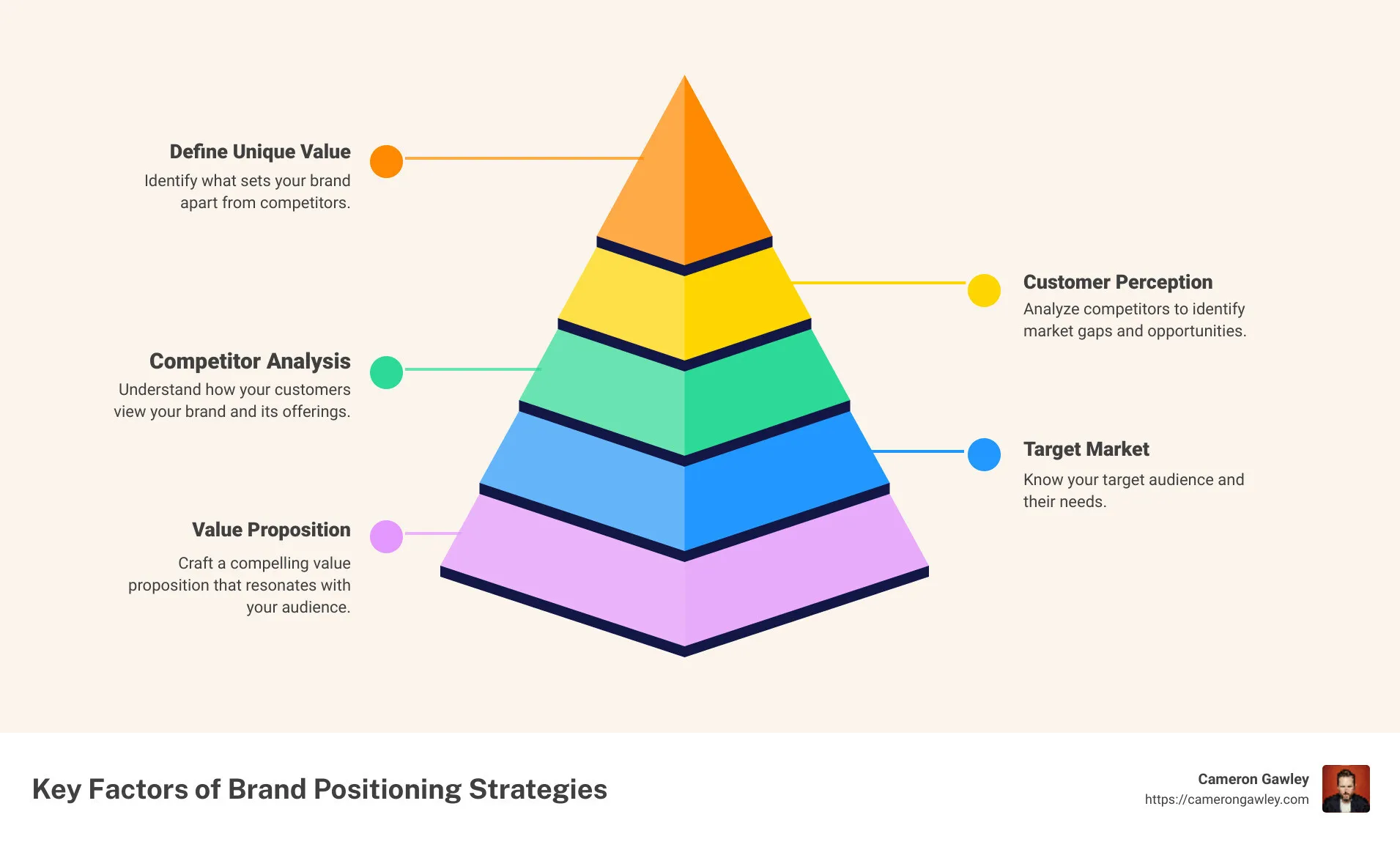
Quick Takeaways for Brand Positioning Strategies:- Define your brand’s unique value.- Understand how your customers perceive your brand.- Analyze your competitors to identify market gaps.
Brand positioning is crucial because it shapes how customers think and feel about your brand. It's the unique value you offer that sets you apart from the competition. When done right, it leads to a stronger identity and better customer loyalty.
In the sections that follow, we’ll explore the elements that make up effective brand positioning strategies and how you can implement them for lasting success.
What is Brand Positioning?
The Importance of Brand Positioning
Brand positioning is crucial because it shapes how customers think and feel about your brand. It's the unique value you offer that sets you apart from the competition. When done right, it leads to a stronger identity and better customer loyalty.
Definition: Brand positioning is the process of differentiating your brand from competitors in the market and finding a niche. It’s about creating a unique perception in the minds of your target audience.
Unique Value Proposition: This is the core reason why customers should choose your brand over others. It’s what makes your brand special and valuable. For instance, Tesla’s unique value proposition centers around innovation and sustainability, making it a top choice for eco-conscious consumers.
Customer Associations: Effective brand positioning helps create specific associations in the minds of customers. For example, when people think of McDonald's, they often think of family-friendly environments and consistent quality. These associations influence purchasing decisions and brand loyalty.
Brand Identity: A well-defined brand positioning helps in creating a strong brand identity. This includes your brand’s logo, colors, and messaging, all of which should consistently reflect your unique value proposition. Think of Coca-Cola’s identity, which revolves around happiness and sharing moments.
Customer Loyalty: When customers perceive your brand as unique and valuable, they are more likely to remain loyal. Brands like Apple have mastered this, creating a loyal customer base that eagerly awaits new product releases.
Competitive Advantage: A strong brand positioning gives you a competitive edge. It helps you stand out in a crowded market, making it easier for customers to choose your brand over others. For example, FedEx’s brand positioning around “overnight shipping” has made it a leader in the logistics industry.
In the sections that follow, we’ll explore the elements that make up effective brand positioning strategies and how you can implement them for lasting success.
Key Elements of a Brand Positioning Strategy
Creating a Brand Positioning Statement
Creating a compelling brand positioning statement is crucial for defining how your brand is perceived in the market. This statement acts as a compass, guiding all your marketing efforts and ensuring consistency across all channels. Here’s how to craft one:
Target Market
First, identify your target market. This is the specific group of consumers you want to reach. Understanding your target market helps you tailor your messaging to resonate with them. Create a detailed buyer persona, including:
- Age
- Relationship status
- Profession
- Income
- Gender identity
- Hobbies
- Habits
- Pain points
For example, if you’re a tech company targeting young professionals, your buyer persona might be a 30-year-old software engineer who values efficiency and innovation.
Value Proposition
Your value proposition is the unique value your brand offers to its customers. It should clearly articulate why your product or service is the best choice. This includes:
- Specific benefits: What does your product solve for the customer?
- Unique features: What makes your product stand out?
Think of your value proposition as the bridge between your brand promise and your customer's needs. For instance, Apple’s value proposition revolves around innovative technology and user-friendly design.
Differentiation
Differentiation is what sets you apart from competitors. It’s not enough to claim you’re the best; you need to prove it. Focus on:
- Unique selling points (USPs): What do you offer that others don’t?
- Market gaps: What needs are unmet by your competitors?
Nike, for example, differentiates itself through its commitment to quality and its powerful brand image. Their slogan, "Just Do It," resonates across various demographics, making them a leader in the sportswear industry.
Target Audience
Your target audience is a subset of your target market. They are the people most likely to buy your product. Your positioning statement should speak directly to them. For instance, if you’re selling eco-friendly products, your target audience might be environmentally conscious millennials.
Unique Benefits
Highlight the unique benefits your brand offers. These are the specific advantages that make your product or service the best option. Use clear, compelling language to describe these benefits. For example, Tesla emphasizes its vehicles' sustainability and cutting-edge technology.
Proof Points
Lastly, include proof points to back up your claims. These can be:
- Customer testimonials
- Case studies
- Statistics
For example, you might say, "9 out of 10 customers prefer our product over competitors." This adds credibility and reassures potential customers that you deliver on your promises.
By focusing on these elements, you can create a powerful brand positioning statement that captures your brand’s essence and appeals to your target audience.
In the next sections, we’ll delve into different types of brand positioning strategies and how to choose the right one for your business.
Types of Brand Positioning Strategies
Choosing the right brand positioning strategy is crucial for standing out in a crowded market. Here are five common strategies that can help you define and communicate your brand's unique value.
Quality-Based Positioning Strategy
A quality-based positioning strategy focuses on presenting your brand as the epitome of premium quality and excellence. This approach is ideal for brands that emphasize:
- Superior craftsmanship
- High-quality materials
- Exceptional performance
For instance, Apple uses a quality-based strategy by highlighting its superior design and cutting-edge technology. This strategy appeals to customers willing to pay a premium for top-notch products.
Price-Based Positioning Strategy
A price-based positioning strategy aims to position your brand as the most affordable option in the market. This strategy targets price-sensitive customers who prioritize:
- Competitive pricing
- Cost-effectiveness
- Budget-friendly options
Spotify excels in this area by offering a free plan along with its premium options, making it more accessible to a broader audience. However, be cautious—this strategy can sometimes give the impression of lower production quality.
Customer Service Positioning Strategy
A customer service positioning strategy centers on delivering outstanding service and building strong relationships. Brands that excel in this area focus on:
- Outstanding service
- Strong relationships
- Personalized experiences
Chick-fil-A is a great example. They rarely boast about their stellar customer service but let their employees' actions speak for themselves. This approach can justify higher price points and turn initially unhappy customers into loyal promoters.
Convenience-Based Positioning Strategy
A convenience-based positioning strategy highlights how your brand offers the most convenient solutions. This strategy appeals to busy consumers who value:
- Hassle-free purchasing
- Fast delivery
- User-friendly interfaces
Amazon Prime is a prime example (pun intended). It offers fast delivery and a seamless shopping experience, making it the go-to choice for convenience.
Social Media Positioning Strategy
A social media positioning strategy is essential. This strategy focuses on building a strong presence on social media platforms to:
- Engage with the target audience
- Craft a compelling brand image
- Enhance brand reputation
By being active and influential on social media, brands can connect with a broader audience. This strategy is particularly effective for brands aiming to resonate with younger, tech-savvy consumers.
By understanding and implementing these brand positioning strategies, you can effectively differentiate your brand and connect with your target audience. In the next section, we'll explore how to create a brand positioning strategy in six steps.
How to Create a Brand Positioning Strategy in 6 Steps
Creating a brand positioning strategy can seem overwhelming, but breaking it down into six manageable steps makes it easier to tackle. Let’s dive in.
Step 1: Understand Your Current Brand Positioning
Before you can move forward, you need to know where you stand. This means understanding how your customers currently perceive your brand. Conduct surveys, gather customer feedback, and study market trends to get a clear picture.
Create a buyer persona to define your ideal customer. Include details like age, profession, income, hobbies, and pain points. This helps you focus on who you’re targeting.
Step 2: Identify Your Competitors
Knowing your competition is crucial. Identify your main competitors and analyze their strengths, weaknesses, and strategies. Look for market gaps and unique selling points that can set your brand apart.
Conduct competitor research by examining their customer reviews and social media presence. This will help you understand what they’re doing right and where they’re falling short.
Step 3: Create Your Unique Value Proposition
Your unique value proposition (UVP) is the core of your brand positioning. It’s the connection between your brand promise and your customer’s needs. Focus on the specific benefits and solutions you offer.
Your UVP should address customer pain points and highlight why your brand is the best fit for their needs. Make it clear, compelling, and memorable.
Step 4: Create Your Positioning Statement
Your positioning statement is a concise message that captures your brand's identity, target audience, and the benefits you deliver. It should answer the questions: What do you do? Who do you serve? How are you different?
A strong positioning statement is simple, easy to remember, and consistent across all communication channels. It should reflect your brand’s mission and values.
Step 5: Test Your Positioning Statement
Testing your positioning statement is crucial to ensure it resonates with your target audience. Use focus groups, surveys, and feedback to gauge reactions. Ask questions like:
- Does this statement clearly explain what we do?
- Does it highlight what makes us unique?
- Does it resonate with your needs and values?
Use the feedback to refine your positioning statement.
Step 6: Reinforce Your Brand’s Distinguishing Qualities
Once you have a solid positioning statement, reinforce it through consistent messaging and brand storytelling. Use customer testimonials and case studies to highlight your unique qualities.
Make sure all customer-facing employees embody your brand values. Consistent messaging across all channels helps build a strong, recognizable brand.
By following these six steps, you can create a brand positioning strategy that sets you apart and resonates with your target audience. Next, we'll look at some examples of effective brand positioning strategies.
Examples of Effective Brand Positioning Strategies
McDonald’s Brand Positioning
McDonald’s has mastered the art of family-friendly and convenience-centered brand positioning. Their tagline, “I’m Lovin’ It,” paired with the iconic golden arches, evokes a sense of warmth and positivity. The brand’s use of bright colors like yellow and red further enhances this cheery image.
Family-friendly elements are everywhere in McDonald’s. From the Happy Meals that include toys to their once-ubiquitous playgrounds, McDonald’s has created an environment that appeals to parents and kids alike. This consistent approach has made McDonald’s a go-to option for families looking for a quick and enjoyable meal.
Convenience is another pillar of McDonald’s brand positioning. Their drive-thru services, extended operating hours, and strategically placed locations in high-traffic areas make it easy for customers to grab a meal on the go. This focus on convenience ensures that McDonald’s remains a top choice for busy individuals and families alike.
Tesla’s Brand Positioning
Tesla stands out as a beacon of innovation, sustainability, and technology. The company revolutionized the electric vehicle (EV) market by being one of the first to produce and market electric cars successfully to the masses.
Tesla’s vehicles are packed with cutting-edge technology, from self-driving capabilities to over-the-air software updates. This tech-driven approach, combined with sleek, futuristic designs, sets Tesla apart from traditional gasoline-powered vehicles. The brand’s focus on sustainability—promoting a cleaner, greener future—further strengthens its unique position in the market.
Tesla’s commitment to innovation is evident in its continuous advancements in battery technology and energy-efficient drivetrains. This relentless pursuit of technological excellence not only differentiates Tesla but also positions it as a leader in the EV industry.
Coca-Cola’s Brand Positioning
Coca-Cola excels in creating an emotional connection with its audience through storytelling. The brand’s marketing campaigns often focus on universal themes like happiness, togetherness, and sharing. For instance, the “Share a Coke” campaign encouraged people to connect by sharing a Coke, reinforcing the idea that Coca-Cola brings people together.
Coca-Cola uses consistent narratives in its advertising to evoke feelings of joy and refreshment. Whether it’s the heartwarming holiday ads featuring the Coca-Cola polar bears or everyday moments of sharing a Coke, the brand’s storytelling techniques create a global appeal that resonates with people from all walks of life.
By consistently emphasizing themes of happiness and togetherness, Coca-Cola has successfully positioned itself as a symbol of joy and refreshment. This emotional connection makes the brand relatable and appealing, fostering a strong bond with consumers worldwide.
Next, we'll delve into frequently asked questions about brand positioning strategies to further clarify this critical marketing concept.
Frequently Asked Questions about Brand Positioning Strategies
What are the five positioning strategies?
- Quality-Based Positioning: This strategy focuses on premium quality, superior craftsmanship, and high performance. Brands like Apple and Tesla use this approach to attract customers willing to pay more for top-notch products.
- Price-Based Positioning: Here, the brand is positioned as the most affordable option. It targets price-sensitive customers looking for cost-effective solutions. Think of budget airlines and discount retailers.
- Customer Service Positioning: This strategy emphasizes outstanding service and strong customer relationships. Brands like Zappos are known for their exceptional customer care, creating loyal customer bases.
- Convenience-Based Positioning: This approach makes the buying experience as easy and efficient as possible. Amazon excels at this by offering fast delivery and a user-friendly shopping experience.
- Social Media Positioning: Brands build a strong presence and engage with their audience on social media platforms. Companies like Glossier leverage social media to create a relatable and influential brand image.
What is a brand positioning strategy?
A brand positioning strategy is a plan to differentiate your brand in the market. It defines how you want your brand to be perceived by your target audience. This involves creating a unique value proposition—a clear statement that explains why your product or service is better than the competition.
A strong positioning strategy helps in building a distinct brand identity and communicates your brand's core values and benefits to your customers. It ensures that your brand stands out and is easily recognizable among competitors.
What are the 7 positioning methods in marketing?
- Product Characteristics: Highlighting unique features or benefits of a product. For example, Volvo emphasizes safety features in its cars.
- Pricing: Positioning based on cost, either as a premium product or a budget-friendly option. Stores like Walmart focus on low prices.
- Use/Application: Positioning based on how a product is used. For instance, Gatorade is marketed as a sports drink for athletes.
- Product Process: Emphasizing the unique process of creating the product. Brands like Ben & Jerry’s highlight their unique ice cream-making process.
- Product Class: Positioning within a specific category. For example, Silk positions itself as a leading brand in the plant-based milk category.
- Cultural Symbols: Using cultural icons or symbols to create a brand identity. Think of Marlboro and its association with the rugged cowboy image.
- Competitors: Positioning against competitors by highlighting differences. Pepsi often positions itself directly against Coca-Cola in its marketing campaigns.
By understanding and applying these positioning methods, brands can effectively carve out a niche in the market and resonate with their target audience.
Conclusion
Brand positioning is crucial for standing out in a crowded marketplace. It helps create a unique identity for your brand, making it memorable and preferred by your target audience. A strong brand position can lead to increased customer loyalty, better market share, and a competitive edge.
Strategic implementation of brand positioning involves understanding your current brand perception, identifying competitors, and defining your unique value proposition. By crafting a compelling positioning statement and reinforcing it through consistent messaging, you can ensure your brand stays top-of-mind for consumers.
At Cameron Gawley, we specialize in helping businesses develop effective brand positioning strategies. Our expertise in brand building ensures that your brand not only stands out but also connects deeply with your audience. Whether you need help with brand research, creating a unique value proposition, or executing a comprehensive brand strategy, we are here to guide you every step of the way.
For more insights and expert advice on brand positioning, visit our brand building services page.

By following the steps and strategies outlined in this article, you can create a powerful brand positioning strategy that drives success and growth for your business. The key to effective brand positioning is to be clear, consistent, and compelling.
If you have any questions or need further assistance, reach out to us. We're here to help you build a brand that stands out and thrives in the market.